As lithium battery technology continues to evolve, energy storage systems are becoming increasingly diverse in terms of voltage, capacity, power, and application scenarios. Among the available options, high-voltage lithium batteries and low-voltage lithium batteries are two common configurations used for energy storage and backup power.
So, what is the difference between high-voltage and low-voltage lithium batteries? What are their respective advantages? And which battery system is more suitable for your project?
This article explains the key differences between high-voltage and low-voltage lithium batteries and introduces how EverExceed provides lithium battery solutions for different energy storage and backup power requirements.
In energy storage applications, lithium battery systems operating at relatively high DC voltage levels are generally referred to as high-voltage battery systems. Depending on the system design and application, high-voltage battery configurations can range from hundreds of volts to higher DC voltage levels.
Compared with conventional low-voltage battery systems, high-voltage configurations connect multiple battery modules or cells in series to achieve a higher system voltage.
EverExceed provides a range of high-voltage LiFePO₄ battery solutions designed for UPS backup power, data centers, commercial and industrial energy storage, and other critical power applications.
Explore EverExceed Lithium Battery Solutions
One major advantage of high-voltage battery systems is their ability to deliver the same power at a lower current.
According to the basic power relationship:
P = V × I
For the same power output, increasing the system voltage reduces the required current. Lower current can help reduce resistive losses and heat generation in cables and electrical components, which can contribute to higher system efficiency.
This makes high-voltage lithium batteries particularly suitable for applications requiring higher power output and larger energy capacity.
High-voltage battery systems can be configured by connecting multiple battery modules or clusters in series.
This modular architecture allows the battery system to be configured according to the required voltage, capacity, backup time, and power level.
For commercial and industrial energy storage or UPS applications, a modular high-voltage architecture can also simplify system expansion and integration.
High-voltage battery systems are well suited to applications where large amounts of power need to be delivered to critical loads.
By operating at a higher DC voltage, the system can reduce current requirements while supporting high-power loads. This makes high-voltage lithium batteries suitable for applications such as data center UPS backup, commercial and industrial energy storage, and other critical power systems.
EverExceed high-voltage UPS lithium battery solutions are designed to work with UPS systems and provide reliable backup power for mission-critical applications. The solutions can incorporate intelligent BMS monitoring and modular configurations for system-level power management.
In energy storage and backup power applications, battery systems such as 12V, 24V, 48V and 51.2V are commonly used as low-voltage configurations.
These batteries are widely used in applications where relatively moderate power levels, easy installation, flexible configuration, and cost-effective system integration are important.
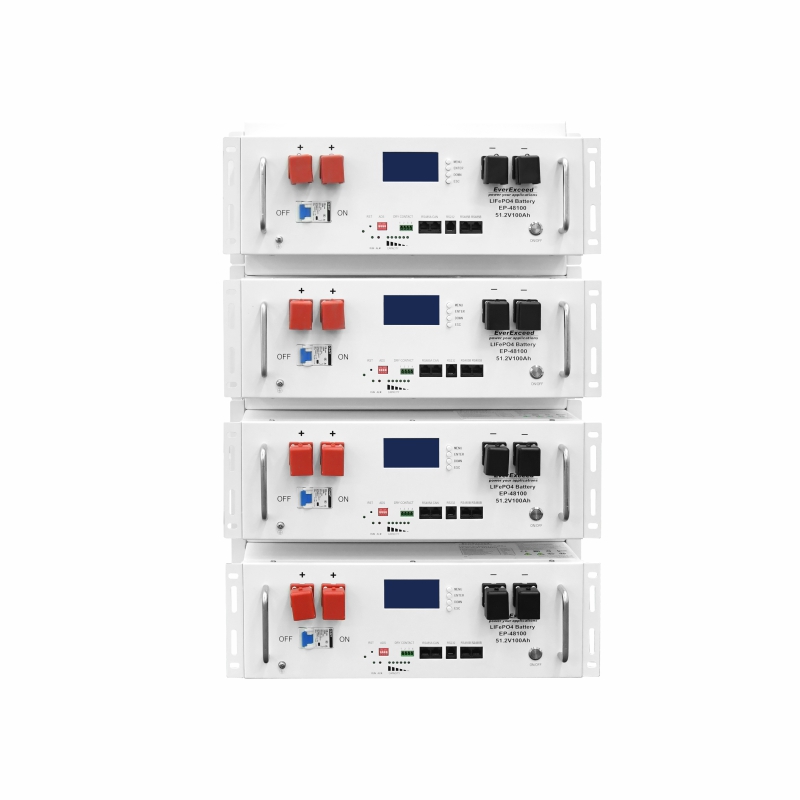
EverExceed offers a wide range of low-voltage LiFePO₄ batteries, including 12V/24V lead-acid replacement batteries and 48V/51.2V lithium battery systems for solar energy storage, telecom backup power, UPS backup, and other applications.
Low-voltage battery systems generally have simpler electrical configurations and can be easier to install, configure, and maintain.
For small and medium-sized energy storage systems, this can help simplify system integration and reduce installation complexity.
Low-voltage lithium batteries can provide a practical solution for applications that do not require extremely high power output.
Depending on the system requirements, a low-voltage configuration can reduce the complexity of the overall battery architecture while still providing the benefits of LiFePO₄ technology, including long cycle life, high energy efficiency, and intelligent battery management.
EverExceed's low-voltage LiFePO₄ battery solutions include 12V and 24V configurations designed for applications such as UPS backup, solar energy storage, and lead-acid replacement.
The choice between high-voltage and low-voltage lithium batteries depends on the application's power requirements, energy capacity, installation environment, backup duration, and system architecture.
| Feature | Low-Voltage Lithium Battery | High-Voltage Lithium Battery |
|---|---|---|
| Typical configuration | 12V / 24V / 48V / 51.2V | Hundreds of volts or higher |
| System complexity | Relatively simple | More complex |
| Installation | Generally easier | Requires professional system integration |
| Current at the same power | Higher | Lower |
| High-power applications | Suitable for small to medium loads | Well suited to high-power loads |
| Scalability | Modular configuration available | Highly suitable for modular high-capacity systems |
| Typical applications | Residential ESS, telecom, UPS backup, solar | Data centers, C&I ESS, high-power UPS |
| Main consideration | Simplicity and flexibility | Power density and system efficiency |
The appropriate voltage level should ultimately be selected according to the requirements of the complete energy storage or backup power system rather than the battery voltage alone.
Low-voltage lithium batteries are commonly used in residential solar energy storage systems to store electricity generated by solar panels during the day and supply power to household loads when solar generation is unavailable.
For example, EverExceed offers 12V/24V LiFePO₄ batteries for solar energy storage and lead-acid replacement applications.
EverExceed 12V/24V LiFePO₄ Battery Solutions
Low-voltage lithium batteries can also provide backup power for critical appliances, communication equipment, small UPS systems, and other electrical loads during power outages.
Their relatively simple configuration makes them suitable for projects where moderate backup capacity and flexible installation are required.
48V and 51.2V lithium battery systems are widely used for telecom backup applications.
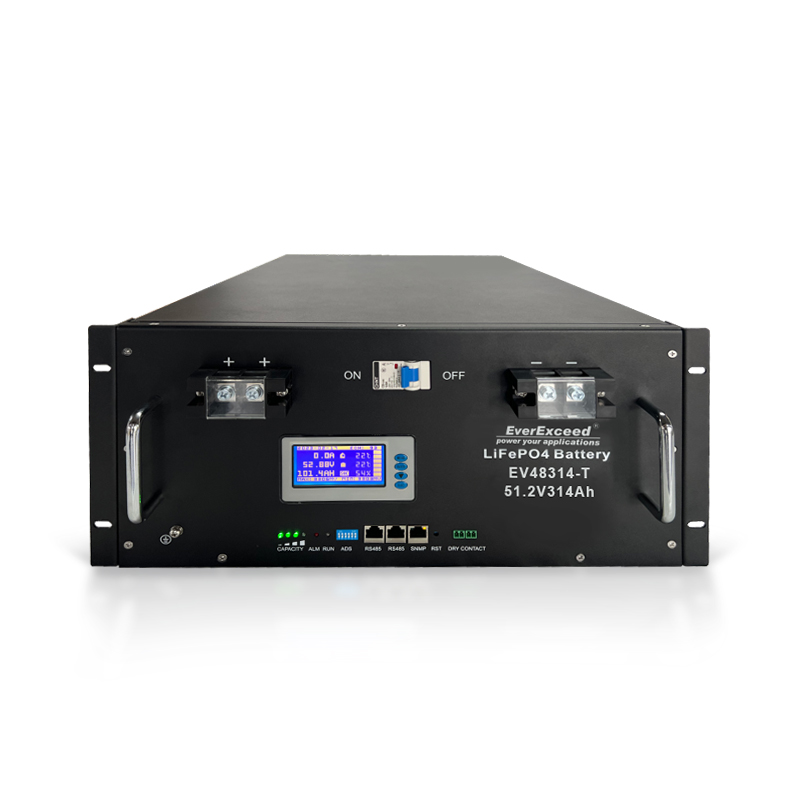
EverExceed's 48V/51.2V LiFePO₄ battery solutions are designed for telecom base stations, energy storage, and emergency backup applications, with intelligent BMS technology for monitoring and protection.
EverExceed 48V / 51.2V LiFePO₄ Battery for Telecom & Energy Storage
High-voltage lithium battery systems are suitable for commercial and industrial energy storage applications that require larger energy capacity and higher power output.
They can be integrated with renewable energy systems and power conversion equipment for applications such as backup power, peak shaving, and energy management.
EverExceed provides high-voltage LiFePO₄ energy storage solutions for commercial and industrial applications, with modular configurations designed for different power and capacity requirements.
EverExceed High-Voltage Energy Storage Solutions
Data centers require highly reliable backup power systems to protect servers, networking equipment, storage systems, and other mission-critical loads.
For these applications, high-voltage lithium batteries can be integrated with UPS systems to provide reliable backup power while supporting high-power loads and efficient system design.
EverExceed provides high-voltage UPS lithium battery solutions specifically for data center backup applications. Its solutions can be configured with UPS systems and high-voltage LiFePO₄ battery clusters to provide continuous backup power for critical data center loads.
For example, EverExceed has developed an 80kVA UPS and 96kWh high-voltage lithium battery solution for data centers, integrating the UPS and high-voltage battery system for coordinated power management and monitoring.
For larger applications, EverExceed also provides high-voltage UPS battery configurations such as 192V, 240V, 384V and 512V systems, supporting different UPS architectures and backup power requirements.
EverExceed High-Voltage UPS Lithium Battery Solutions
80kVA UPS System with 96kWh High-Voltage Lithium Battery for Data Center Backup
When selecting a lithium battery system, consider the following factors:
If the system needs to support high-power loads, a high-voltage battery architecture can help reduce current requirements and improve the overall electrical design.
For smaller loads and moderate backup requirements, a low-voltage battery system may provide a simpler solution.
Larger energy storage systems generally benefit from modular high-voltage architectures, especially when the system needs to support large energy capacity and long backup durations.
Consider available installation space, electrical infrastructure, cooling requirements, maintenance access, and safety requirements.
Battery voltage must match the requirements of the UPS, inverter, PCS, or other power conversion equipment.
For UPS applications in particular, the battery voltage, charging parameters, communication protocol, BMS configuration, and UPS compatibility should be evaluated as part of the complete system.
If the project may require additional energy capacity or power in the future, a modular battery architecture can provide greater flexibility for system expansion.
Choosing between a high-voltage and low-voltage lithium battery is not simply a matter of selecting a higher or lower voltage. The right configuration depends on the project's power demand, energy capacity, backup duration, installation environment, and compatibility with the overall power system.
With lithium battery solutions covering low-voltage LiFePO₄ batteries, 48V/51.2V telecom batteries, UPS lithium batteries, and high-voltage lithium battery systems, EverExceed provides battery solutions for different energy storage and backup power requirements.
For data center applications, EverExceed combines UPS systems with high-voltage lithium batteries to provide integrated backup power solutions for critical loads. Its data center portfolio includes high-voltage UPS lithium battery systems and customized UPS solutions for different power and backup requirements.
Whether your project requires a compact low-voltage lithium battery or a high-voltage UPS battery system for a data center, selecting the appropriate voltage architecture is an important step toward building a reliable, efficient, and scalable power system.
Looking for a lithium battery solution for your project? Contact EverExceed for a customized battery and backup power solution.
categories
recent posts




scan to wechat:everexceed