Industrial battery charger topology selection mainly depends on power level, efficiency requirements, thermal management, and application conditions.
Boost PFC is a simple and cost-effective solution widely used in industrial charger designs, while Totem Pole PFC provides higher efficiency and power density by eliminating bridge rectifier losses, making it suitable for high-power applications.
With the adoption of SiC MOSFET technology, modern industrial chargers can achieve higher switching frequency, lower power losses, improved efficiency, and more compact designs.
· Industrial battery chargers require high reliability, efficiency, and compact design for demanding environments.
· SiC power devices enable high-frequency operation with lower switching and conduction losses.
· Boost PFC provides a mature and economical solution for general industrial charger applications.
· Totem Pole PFC improves efficiency and power density for high-power charger systems.
· The optimal topology depends on application requirements, output power, and thermal design.
Battery-powered equipment, including power tools, lawn equipment, forklifts, pallet trucks, and automated guided vehicles (AGVs), is becoming increasingly common in industrial and construction applications.
Industrial battery chargers must provide:
· Reliable operation in harsh environments
· Compact and lightweight design
· High efficiency with reduced cooling requirements
· Compatibility with different AC input voltages, including 120–277 VAC and 480 VAC
Industrial chargers typically consist of:
PFC front-end stage + Isolated DC-DC converter stage
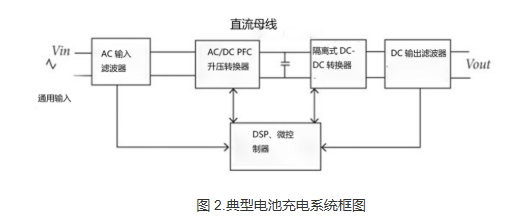
The DC-DC stage provides constant voltage and constant current charging control for different battery types, including:
· Lead-acid batteries
· Nickel-metal hydride batteries
· Lithium-ion batteries
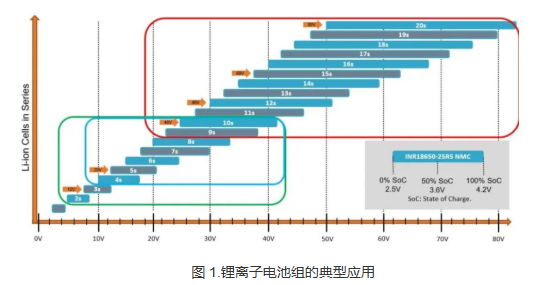
Most new industrial equipment uses 12V–120V lithium-ion and LiFePO₄ battery systems.
Silicon carbide (SiC) power devices are becoming increasingly popular because they support:
· Higher switching frequency
· Lower switching losses
· Lower conduction losses
· Higher temperature operation
· Higher power density
These advantages allow industrial battery chargers to achieve:
· Higher efficiency
· Smaller heatsinks
· Natural convection cooling
· More compact system designs
Compared with traditional IGBT-based solutions, SiC technology also enables advanced PFC topologies for higher-performance charger systems.
Continuous conduction mode (CCM) Boost PFC is a widely used solution for industrial battery chargers due to its simple structure and cost effectiveness.
The topology includes:
· Input EMI filter
· Bridge rectifier
· Boost inductor
· Boost MOSFET
· Boost diode
A fixed-frequency average current mode controller can achieve:
· High power factor
· Low total harmonic distortion (THD)
· Stable output voltage regulation
Recommended controllers include:
· NCP1654
· NCP1655 CCM PFC controller
For higher-power applications, interleaved PFC controllers such as:
· FAN9672
· FAN9673
can be used.
650V EliteSiC diodes and EliteSiC MOSFETs are suitable for high-frequency and high-power applications, including 2kW–6.6kW charger systems.
In high-power applications, bridge rectifier losses become significant. Replacing the diode bridge with active switches can reduce power losses and improve efficiency.
Totem Pole PFC eliminates the traditional bridge rectifier and consists of:
· EMI filter
· Boost inductor
· High-frequency half bridge
· Low-frequency half bridge
· Two-channel gate driver
· NCP1681B PFC controller
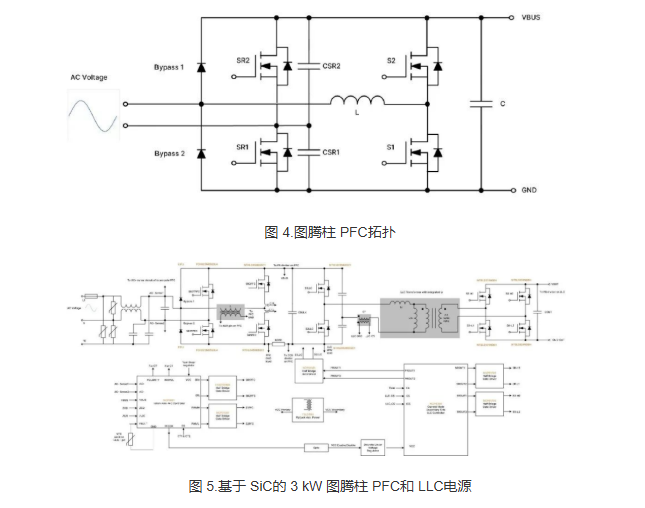
The high-frequency branch requires power switches with low reverse recovery time.
SiC and GaN devices are suitable for this application because they provide excellent switching performance.
Typical applications:
|
Power Range |
Recommended Technology |
|
600W–1.2kW |
iGaN with integrated gate driver |
|
1.5kW–6.6kW |
SiC MOSFET |
|
4kW–6.6kW |
Interleaved Totem Pole PFC |
|
Feature |
Boost PFC |
Totem Pole PFC |
|
Circuit structure |
Simple |
More advanced |
|
Cost |
Lower |
Higher |
|
Bridge rectifier |
Required |
Removed |
|
Power losses |
Higher |
Lower |
|
Efficiency |
High |
Higher |
|
Power density |
Moderate |
Higher |
|
Application |
General industrial chargers |
High-power chargers |
A typical high-efficiency industrial charger can combine:
· SiC-based Totem Pole PFC
· LLC isolated DC-DC converter
A 3kW SiC Totem Pole PFC design can use:
· 650V EliteSiC MOSFETs
· High-frequency switching operation
· Reduced thermal requirements
Example SiC MOSFET selections:
3kW applications:
· NTH4L045N065SC1
· NTH4L032N065M3S
6.6kW applications:
· NTH4L015N065SC1
· NTH4L012N065M3S
This architecture helps achieve:
· Higher efficiency
· Higher power density
· Smaller cooling systems
· Improved reliability
The selection depends on charger requirements:
|
Application Requirement |
Recommended Topology |
|
Cost-effective industrial charger |
Boost PFC |
|
General-purpose battery charger |
Boost PFC |
|
Higher efficiency requirement |
Bridgeless PFC |
|
High-power industrial charger |
Totem Pole PFC |
|
3kW–6.6kW charger system |
SiC-based Totem Pole PFC |
PFC improves power factor, reduces harmonic distortion, and increases system efficiency.
SiC MOSFETs enable higher switching frequency, lower losses, and improved thermal performance.
Yes. Boost PFC remains a reliable and economical solution for many industrial charging applications.
Totem Pole PFC removes the bridge rectifier, reducing losses and improving efficiency and power density.
The choice of PFC topology plays an important role in industrial battery charger performance.
Boost PFC provides a mature and cost-effective solution for many applications, while Totem Pole PFC combined with SiC MOSFET technology enables higher efficiency and power density for advanced high-power charger systems.
As industrial equipment continues to move toward electrification, optimized power conversion solutions will become increasingly important for reliable and efficient battery charging.
A Global Leading Manufacturer of Customized AC/DC Power Solutions
20+ Years of Battery Manufacturing Experience
10+ years System Integration Experience
categories
recent posts




scan to wechat:everexceed